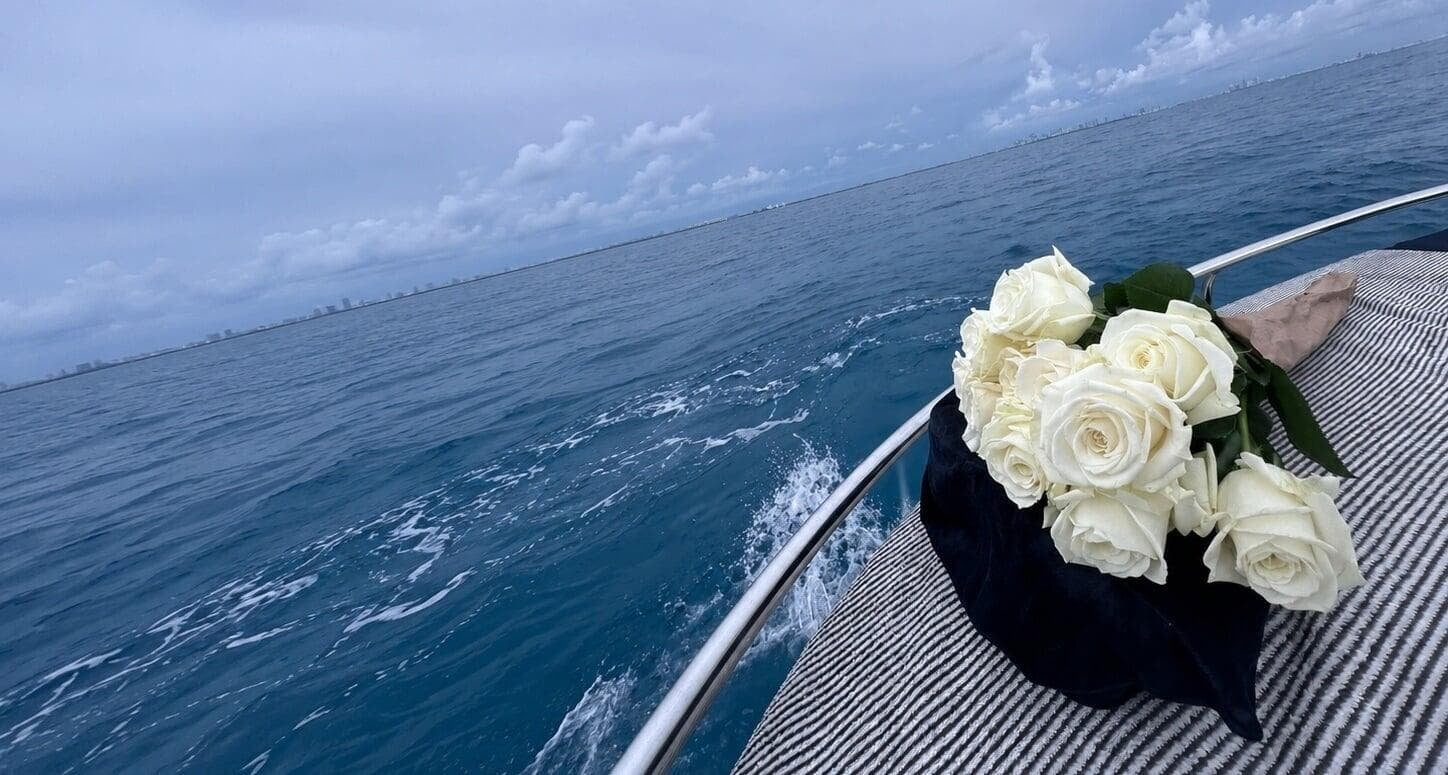
Most families planning a sea farewell have never been to one. They know they want the ocean, but the day itself is harder to picture, and not knowing what to expect can make the decision harder than it needs to be. Here is what a sea farewell in Miami actually involves, from choosing the spot to what comes back with you afterward.
Choosing Where
The Trip Out
At the Site
When we reach the chosen area, the captain anchors and the engines stop.
On an attended trip, who releases the ashes is your decision. Some families prefer to do it themselves; others would rather our crew carry it out while they watch. Either is fine, and you do not need to decide in advance — if it feels like too much on the day, the crew will take over. Before leaving the site, the captain records the exact GPS coordinates.
Flowers are the most common addition, and the choice is yours: the type, the color, or whether there are any at all. The same goes for everything else — music, a reading, a prayer, a few words from a grandchild, or complete silence. There is no script. Anything synthetic stays ashore, since plastic flowers, artificial wreaths, and ribbon will not break down in the ocean.
If You Are Not There
An unattended farewell follows the same route and the same rules, carried out by our crew on your behalf. The vessel travels to a quiet stretch of water and anchors, exactly as it would with your family aboard. One crew member releases the ashes while another records it, so the scattering is documented as it happens rather than described to you afterward.
Everything else is yours to decide. You choose the flowers. You can tell us where, if there is a place that matters. The captain records the coordinates at the site, files the required documentation with the EPA, and signs the certificate that comes back to you with your loved one's name, the date, and the exact position.
What you are not there for is the boat ride. Everything that happens at the site happens the same way.
What You Take Home
The coordinates appear on your Certificate of Burial at Sea, alongside your loved one's name, the date of the scattering, and the signature of the U.S. Coast Guard licensed captain who carried it out — an exact latitude and longitude rather than a vague stretch of ocean.
That gives you somewhere specific: a point you can mark on a map at home, share with relatives who could not travel, or return to by boat.
Planning Yours
If you are thinking about a sea farewell in Miami and want to talk through what your family’s day would look like, we are glad to walk you through it.